Digital advertising is one of the most powerful growth tools available to businesses today — and the data proves it. Search ads alone deliver an average 200% ROI, while email marketing generates $36–$40 for every $1 spent. Yet many businesses still struggle to get results because their advertising strategy lacks direction, depth, or the right digital marketing foundation.
In the digital marketing world, advertising holds a significant position because it improves brand awareness, drives engagement, and converts leads into paying customers. With the vast reach and precise targeting offered by digital platforms, advertising has evolved from a one-way broadcast into an interactive, data-driven experience — one that can be measured, optimized, and scaled in real time.
With the vast reach and precise targeting offered by digital platforms, advertising has evolved from a one-way broadcast to an interactive, engaging experience for consumers.
In this guide, we will break down exactly how digital marketing makes advertising more effective — covering key strategies, channel-by-channel effectiveness, measurement frameworks, and the 2026 trends shaping the future of online advertising.
What Is Digital Marketing?
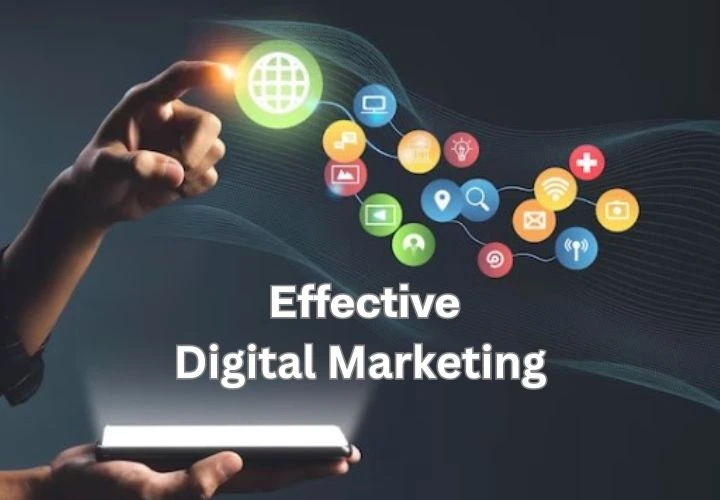
Digital marketing encompasses a broad spectrum of online channels and platforms through which businesses can connect with their target audience. Unlike traditional marketing, which relies on offline media like print, TV, and radio, digital marketing uses the internet, mobile devices, search engines, social media, and data analytics to deliver targeted, measurable campaigns. Many businesses partner with a results-driven digital marketing company to manage these efforts effectively
Digital marketing aims to build brand awareness, drive traffic, generate leads, and strengthen customer relationships through targeted and personalized approaches. It relies on data-driven insights and analytics to optimize campaigns and measure performance metrics like engagement, conversions, and return on investment (ROI).
The process moves forward by choosing the right promotional activity that reaches users through digital advertising, whose success is eventually calculated based on sales.
Understanding the distinction is important: Digital advertising is a subset of digital marketing. Advertising refers specifically to paid promotional content — Google Ads, social media ads, display banners, video pre-rolls. Digital marketing is the broader ecosystem that includes SEO, content marketing, email, social media, and paid advertising working together toward a shared goal.
Core components of digital marketing:
- Search Engine Optimization (SEO)
- Content Marketing
- Social Media Marketing
- Email Marketing
- Pay-Per-Click (PPC) Advertising
- Programmatic & Display Advertising
- Video Advertising
Key advantages of digital marketing over traditional methods:
- Reaches global audiences with geographic precision through geo-targeting and localization
- Enables precise audience targeting based on demographics, interests, behaviors, and purchase intent
- Provides real-time analytics, allowing campaign optimization based on live performance data
- Significantly more cost-effective than TV, print, or radio — with measurable ROI at every stage
- Allows A/B testing of creatives, messaging, and landing pages to continuously improve results
Overall, digital marketing is defined as using numerous digital tactics and channels to connect with customers and fulfill their needs. The new technologies and trends of digital marketing encourage companies and brands to change their marketing strategies and set their budgets accordingly — moving spend toward channels that deliver verifiable, trackable returns.
Why Is Digital Advertising Effective? 7 Data-Backed Reasons
Digital marketing is a valuable element for your business’s growth and helps you establish a strong online presence. But why exactly does it work so well? Here are seven evidence-backed reasons why digital advertising consistently outperforms traditional methods.
89 percent of marketers say methods like search engine optimization (SEO) are successful. And when paired with paid advertising, the results compound significantly, which is why many businesses partner with an experienced SEO agency.
1. Unmatched Audience Targeting
To drive the desired results for your business, you need to build a strong online presence that reaches the right people — not just a broad audience. Digital advertising allows you to target users based on demographics (age, gender, income), psychographics (interests, values, lifestyle), behavioral signals (purchase history, browsing patterns), and even life events.
Over 5.4 billion people use the Internet across the globe — and digital advertising lets you reach exactly the segment most likely to buy from you, rather than broadcasting to everyone and hoping for the best.
A good digital marketing strategy for your brand will incorporate audience targeting as its foundation — because relevance is what drives clicks, conversions, and return on ad spend (ROAS).
You can opt for multiple digital marketing channels to expand your brand’s online presence through precisely targeted advertising, which includes:
- Search engines (Google Ads, Bing Ads)
- Video platforms (YouTube, CTV)
- Social media (Meta, TikTok, LinkedIn)
- Programmatic display networks
- Email campaigns
- Pay-per-click (PPC) ads
2. Superior Cost-Effectiveness vs. Traditional Advertising
Another crucial benefit of digital advertising is that it allows you to acquire new customers at a dramatically lower cost compared to traditional marketing. Customer acquisition cost (CAC) — the total amount your business spends on average to acquire a new customer — is measurably lower across digital channels.
Many traditional marketing methods, such as TV spots, billboard ads, and print campaigns, are expensive, non-trackable, and unable to be adjusted once launched.
Content marketing costs 62% less than traditional marketing methods — and generates 3x more leads.
Digital advertising cost models are also flexible. With pay-per-click (PPC), you only pay when a user clicks your ad. With cost-per-acquisition (CPA) bidding, you pay only when a desired action is completed. The average CPA for paid search is $49, compared to hundreds of dollars in traditional direct mail. This maximizes the ROI for your business while keeping budgets under control.
Cost-effective digital marketing enables you to:
- Target relevant audiences and eliminate wasted impressions
- Generate high-quality leads at a lower cost per lead
- Increase conversion rates through continuous optimization
- Track and optimize campaigns in real-time with tools like Google Analytics 4
- Scale spend up or down instantly based on performance
3. Precise Targeting of Your Ideal Audience
Through digital marketing, you can target a wide yet precisely defined audience for your business. The ability to reach the right person at the right time with the right message is the single biggest reason why digital advertising outperforms traditional alternatives.
Modern digital advertising platforms offer four primary targeting approaches:
- Demographic targeting: Age, gender, income, education, location
- Behavioral targeting: Past purchases, website visits, app usage, search history
- Contextual targeting: Serving ads alongside relevant content topics
- Lookalike audiences: Reaching new users who share characteristics with your best existing customers
You do not have to wait for people to see your marketing efforts, like in traditional marketing. In digital marketing, people get information about your business within seconds based on active intent — they are already searching for what you offer. Then you can use all the important data about your audience in your digital marketing campaigns to make them highly relevant and successful.
4. Real-Time Campaign Tracking and Optimization
Another critical advantage of digital advertising is that you can track, monitor, and optimize your campaigns in real time — something impossible with traditional media. When you invest your budget into advertising campaigns, you need to know exactly how they are performing, which channels are delivering ROI, and where to reallocate spend.
With traditional methods, it is difficult to know the results of your campaign. You have to ask people in your store about which ad brought them in — a process that is complex, time-consuming, and highly inaccurate.
With digital marketing, every campaign is fully trackable. You can monitor:
- Click-Through Rate (CTR): The percentage of users who clicked your ad after seeing it
- Conversion Rate: The percentage of ad clicks that resulted in a desired action
- Return on Ad Spend (ROAS): Revenue generated per dollar of ad spend
- Cost Per Acquisition (CPA): How much you spend to acquire each customer
- Impression Share: What percentage of available impressions your ads captured
- Quality Score: Google’s rating of your ad’s relevance, affecting both placement and cost
This real-time visibility lets you pause underperforming ads, increase budget on winning campaigns, and A/B test creatives to continuously improve performance — capabilities that make digital advertising fundamentally more effective than any offline alternative.
5. Exceptional Return on Investment (ROI)
A successful advertising strategy delivers a measurable return on investment — and digital channels consistently lead all advertising formats in ROI. These are the current benchmarks across major digital channels:
- Email marketing: $36–$40 for every $1 spent — the highest ROI of any marketing channel (3,600%+)
- Search advertising (PPC/Google Ads): Average $2 return for every $1 invested (200% ROI)
- SEO: 49% of businesses say organic search delivers the best long-term marketing ROI
- Social media ads: Average CTR of 1.2–2.01% depending on platform, with strong brand recall
- Video advertising: Improves brand recall by 80% and boosts conversions for 90% of marketers
A high return on investment provides you with the opportunity and capital to grow in the market effectively. The key is applying the right digital marketing techniques to the right channels for your specific business goals — awareness, lead generation, or direct conversion.
Digital Advertising Channels: Effectiveness by Platform
Not all digital advertising channels are equally effective for every goal. Understanding which platform delivers the best results — and why — is fundamental to building an effective digital marketing strategy. Here is how the major channels stack up.
Search Engine Advertising (Google Ads / PPC)
Pay-per-click advertising on search engines is the most intent-driven form of digital advertising. When a user searches for “best digital marketing agency” or “buy running shoes online,” they are actively looking for a solution — and your ad appears at that exact moment of intent.
- Average ROI: $2 returned for every $1 spent (200%)
- Market share: 80% of companies use Google Ads for PPC campaigns
- Average CPC: $2.96 across all industries
- Google’s reach: Controls ~83% of global search ad revenue
Precision with demographics: Google Ads allows advertisers to target specific audiences by age, gender, household income, interests, and past behaviors — ensuring ads are served to the most relevant audience segments. Combined with keyword targeting, this makes search advertising exceptionally cost-effective.
Geo-targeting and localization: Through geolocation data, search ads can be tailored for local audiences — maximizing relevance and increasing the probability of conversion for location-based businesses.
Personalized messaging: Using data analytics and Dynamic Search Ads (DSA), ad copy can be automatically tailored based on user search queries and browsing history — creating a more engaging and relevant experience.
Social Media Advertising (Meta, TikTok, LinkedIn)
Social media advertising delivers exceptional results for brand awareness, audience discovery, and community building. With social ad spend projected at $210 billion globally in 2025, these platforms represent a massive and growing share of digital advertising investment.
- Meta (Facebook + Instagram) CTR: Average 1.2% link click-through rate
- TikTok Ads CTR: 2.01% average — the highest among major social platforms
- LinkedIn: Top platform for B2B lead generation; 40% of B2B marketers cite it as their highest-quality lead source
- Brand discovery: 77% of consumers discover new products through social ads
Interactive content and social engagement: Interactive content — quizzes, polls, Stories, and interactive video — engages users through active participation, creating two-way communication that increases brand awareness and drives higher conversion rates than passive display formats.
User-generated content (UGC): Encouraging users to create and share content related to your brand increases authenticity and social proof, amplifying the reach of advertising efforts far beyond the original paid placement.
Programmatic Display and Retargeting
Programmatic advertising now accounts for approximately 90% of all display ad transactions — an automated, data-driven approach that matches ads to audiences based on behavioral signals across millions of websites in real time.
- Retargeting effectiveness: Retargeted ads deliver up to 10x higher CTR than standard prospecting campaigns
- Dynamic Creative Optimization (DCO): AI-powered creative variation boosts CTR by 32%
- Cross-channel impact: Omnichannel campaigns see an 18.96% engagement rate vs. 5.4% for single-channel campaigns
Data-driven insights: Programmatic platforms provide rich metrics — impression data, viewability rates, conversion paths, and audience overlap reports — allowing advertisers to measure campaign success with precision and allocate budget toward the highest-performing placements.
Real-time optimization: With access to live performance data, bids and placements are automatically adjusted to optimize outcomes — ensuring campaigns remain relevant and efficient, ultimately maximizing ROI without manual intervention.
Customer journey attribution: Advanced attribution models — first-click, last-click, data-driven — allow marketers to understand the full impact of each channel across the conversion path, enabling smarter resource allocation and improving ROI.
Email Marketing and Budget Control
Email remains the highest-ROI digital advertising channel available, delivering $36–$40 for every $1 invested. It combines the targeting precision of digital platforms with a direct, personal line of communication to your audience.
- Budget control: Email marketing is one of the most cost-controllable channels — segmented campaigns, automated triggers, and performance-based optimization ensure efficient use of every marketing dollar
- Quick adaptation: Unlike print or TV, email campaigns can be modified, paused, or A/B tested in real time based on open rates, click rates, and conversion data
- Personalization at scale: Marketing automation platforms allow highly personalized messaging sequences based on user behavior, purchase history, and lifecycle stage
Digital marketing offers flexibility in budget allocation across all channels, allowing advertisers to continuously adjust spending based on performance data and business goals.
How to Make Digital Advertising More Effective: 5 Proven Strategies
Understanding why digital advertising works is only half the equation. Here are five strategies that consistently separate high-performing campaigns from average ones.
1. Anchor Your Campaign in Brand Consistency and Content Strategy
Brand consistency in digital marketing means maintaining uniform messaging, design, and tone across all online channels — from Google Ads copy to social media creatives to landing pages. It builds brand recognition, trust, and loyalty by presenting a cohesive identity at every touchpoint of the customer journey.
Digital marketing facilitates consistent brand messaging across multiple channels, ensuring a unified brand experience that reinforces trust and improves ad performance scores.
SEO and content optimization serve as powerful amplifiers for paid advertising by increasing visibility and driving organic traffic that complements paid campaigns, ultimately reducing customer acquisition costs. Leveraging multiple content formats—such as blogs, videos, infographics, podcasts, and interactive tools—enhances brand storytelling, and many businesses turn to content writing services to execute this effectively.
2. Invest in Creative Quality and Ad Relevance
Ad relevance is one of the most direct levers you have over advertising effectiveness. Google’s Quality Score system rewards highly relevant ads with better placements and lower costs-per-click. On social platforms, relevance scores function similarly.
- Ads with storytelling elements improve recall by 85%
- Landing pages with videos see 53% higher conversion rates
- Short-form video ads (<30 seconds) convert 3x better than long-form equivalents
- Dynamic Creative Optimization (DCO) — automatically tailoring creatives to each audience segment — boosts CTR by 32%
3. Use Retargeting to Recapture High-Intent Prospects
Most website visitors do not convert on their first visit. Retargeting — serving ads specifically to users who have previously interacted with your website, app, or content — is one of the highest-impact tactics in digital advertising.
- Retargeted ads deliver up to 10x higher CTR than cold prospecting campaigns
- Retargeting works directly with inbound marketing efforts: users who found you through SEO or content become retargeting audiences for paid ads
- Platforms like Google Ads and Meta allow highly segmented retargeting based on specific pages visited, time on site, and actions taken
4. Master Audience Segmentation for Maximum Relevance
The more precisely you define who sees your ads, the more effective those ads become. Advanced audience segmentation means breaking your target market into distinct groups based on meaningful criteria and crafting tailored messages for each.
- First-party data: Your own CRM data, email lists, and website behavioral data are your most valuable segmentation asset — especially as third-party cookies are phased out
- Custom audiences: Upload customer lists to platforms like Meta and Google to find exact matches and build lookalike audiences
- Negative audiences: Exclude current customers from acquisition campaigns to avoid wasted spend
- Behavioral signals: Target based on past purchases, cart abandonment, content consumption patterns, and search history
5. Continuously Test, Measure, and Optimize
The single most important practice in digital advertising effectiveness is continuous, systematic testing and optimization. Unlike traditional advertising, digital campaigns can be tested, measured, and improved in real time.
- A/B test: Ad headlines, creative formats, CTAs, landing page layouts, and audience segments simultaneously
- Attribution modeling: Use data-driven attribution in Google Analytics 4 to understand the true contribution of each touchpoint in the conversion path
- Performance benchmarks to monitor: CTR, ROAS, CPA, conversion rate, impression share, and Quality Score
- Optimization tools: Google Ads Smart Bidding, Meta Advantage+ campaigns, and third-party tools like SEMrush and HubSpot for cross-channel visibility
Measuring Digital Advertising Effectiveness: Key KPIs and Tools
You cannot improve what you cannot measure. Defining the right KPIs and using the right tools is fundamental to understanding and improving the effectiveness of your digital advertising campaigns.
Essential KPIs for digital advertising effectiveness:
- Click-Through Rate (CTR): Benchmark — Search ~3.5%, Display ~0.1%, Social ~1.2–2%
- Conversion Rate: Average across industries — 2–5% for landing pages; higher with CRO optimization
- Return on Ad Spend (ROAS): Revenue ÷ Ad Spend; healthy target varies by industry (typically 3:1 to 8:1)
- Cost Per Acquisition (CPA): Avg. $49 for paid search; $75 for display advertising
- Quality Score (Google Ads): 1–10 scale; higher scores reduce CPC and improve ad position
- Impression Share: Percentage of available impressions captured; indicates market visibility
Recommended measurement tools:
- Google Analytics 4 — cross-channel attribution and conversion tracking
- Google Ads Manager — campaign-level performance and Quality Score monitoring
- Meta Ads Manager — social campaign analytics and audience insights
- Google Search Console — organic performance tracking alongside paid data
- HubSpot / SEMrush — integrated marketing performance and ROI dashboards
The Future of Digital Advertising: 2026 Trends Shaping Effectiveness
Digital advertising is evolving faster than ever. Businesses that stay ahead of these trends will see compounding improvements in advertising effectiveness — while those that ignore them risk being outpaced by competitors.
AI and Predictive Analytics
The integration of AI and machine learning is fundamentally transforming digital advertising effectiveness. 82% of marketers report that AI tools improve ad targeting accuracy, and 94% say AI has directly helped grow revenue.
AI and predictive analytics in digital marketing involve using the latest AI-powered algorithms to analyze massive datasets, predict future user behavior, and automatically optimize campaign performance. Key applications include:
- Smart Bidding: Automated bidding strategies that optimize for conversions or ROAS in real time
- Dynamic Creative Optimization (DCO): AI assembles the best-performing ad creative combinations for each individual user
- Predictive audience targeting: Machine learning identifies users most likely to convert before they even visit your site
- Generative AI ad creative: AI-generated copy and visuals at scale, enabling rapid creative testing
Voice Search and Conversational AI
Voice search and AI assistants use natural language processing to interpret spoken queries and deliver relevant results. Marketers optimizing content for voice search are gaining early-mover advantage as this channel grows. Conversational search queries (longer, question-based) are also changing how PPC keyword strategies are built — requiring ad copy and landing pages to match natural language intent.
Emerging Advertising Technologies and Formats
- Connected TV (CTV) advertising: A $45 billion market in 2025, growing 19% year-over-year. CTV ads achieve a 4.2% CTR — dramatically higher than desktop or mobile display
- Short-form video ads: TikTok, Instagram Reels, and YouTube Shorts are the fastest-growing ad formats. Videos under 30 seconds convert 3x better than long-form equivalents
- First-party data and cookieless advertising: As third-party cookies are phased out, building first-party data strategies — email lists, loyalty programs, CRM data — is becoming the defining competitive advantage in digital advertising targeting
- Retail media networks: Amazon Ads and Walmart Connect are projected to reach $140 billion by 2026, offering high-intent purchase advertising directly within shopping environments
- Augmented reality (AR) and immersive experiences: AR and VR ad formats are redefining consumer engagement, providing innovative interactive advertising experiences with measurably higher engagement and recall rates
Frequently Asked Questions About Digital Advertising Effectiveness
Is digital advertising worth it for small businesses?
Yes — digital advertising is especially well-suited for small businesses because of its flexible budget models, precise targeting, and measurable ROI. Platforms like Google Ads and Meta allow campaigns starting at just a few dollars per day, with cost-per-click models ensuring you only pay for actual engagement. For every $1 spent on Google Ads, businesses return an average of $2 — a 200% ROI that is difficult to match with traditional advertising on a limited budget.
What is the most effective form of digital advertising?
The most effective channel depends on your goal. For direct ROI and long-term value, email marketing leads with 3,600%+ ROI. For capturing high-intent buyers ready to purchase, search advertising (PPC) delivers the best results. For brand awareness and audience discovery, social media and video advertising consistently outperform other formats. The highest-performing strategies combine multiple channels in a coordinated, omnichannel approach.
How do I measure the effectiveness of my digital ads?
Measure digital ad effectiveness through key performance indicators: Click-Through Rate (CTR), Conversion Rate, Return on Ad Spend (ROAS), Cost Per Acquisition (CPA), and Quality Score. Use Google Analytics 4 for cross-channel attribution, Google Ads Manager for search campaign data, and Meta Ads Manager for social performance. Establish baseline benchmarks before launching, then monitor weekly and optimize based on data — not assumptions.
Why is digital advertising more effective than traditional advertising?
Digital advertising is more effective than traditional for four fundamental reasons: (1) Targeting precision — you reach specific audiences based on behavior, intent, and demographics rather than broadcasting to everyone; (2) Measurability — every click, conversion, and dollar of ROI is trackable; (3) Cost efficiency — digital CAC is significantly lower with flexible, performance-based pricing models; and (4) Real-time optimization — campaigns can be adjusted, paused, or scaled instantly based on live performance data.
How much should I spend on digital advertising?
Most businesses allocate 5–15% of revenue to their total marketing budget, with digital advertising representing the majority of that spend. For small businesses, start with search advertising (Google Ads) to capture intent-driven demand, then layer in social media and retargeting as budget grows. The key principle: start with channels that have the clearest ROI attribution, measure rigorously, and scale what works. Effective spend in digital marketing is about optimization, not volume.
Do digital ads help with inbound marketing efforts?
Absolutely. Digital advertising and inbound marketing are powerful complements. Paid search ads capture users who are already in the awareness or consideration stage driven by organic content. Retargeting campaigns re-engage inbound visitors who found your site through SEO or content marketing but did not convert. Social ads amplify high-performing organic content to new audiences. Together, inbound and paid digital advertising create a full-funnel strategy that dramatically outperforms either approach used alone.
Conclusion
The effectiveness of advertising through digital marketing comes from the ability to precisely target audiences, engage them with relevant creative, measure results accurately, and adapt in real time — capabilities that simply do not exist in traditional advertising.
Digital marketing has defined advertising for the modern era. It presents a combination of tools, channels, and strategies — from AI-powered targeting to first-party data, from search intent advertising to video and CTV — that empower brands to connect with their audiences in measurable, impactful ways. From targeted audience segmentation to campaign management and performance tracking, scalable digital marketing pricing packages ensure that businesses achieve measurable results from their digital advertising investments.
Through precise targeting, interactive engagement, data-driven insights, and adaptability, digital marketing has fundamentally reshaped how advertising campaigns are conceived, executed, and measured. Businesses that embrace these capabilities — and pair them with consistent testing, strong creative, and smart measurement — will see their advertising effectiveness compound over time.
This guide helps businesses understand the transformative impact of digital marketing on advertising, emphasizing its ability to connect with audiences, drive engagement, adapt to the dynamic digital world, and build the foundation for long-term growth and effectiveness in advertising strategy.